
The All-Too-Familiar Desk Slump
Does this sound familiar? You settle in at your desk with a fresh cup of coffee, start cranking on emails – and before you know it, hours have flown by. When you finally stand up, your neck is stiff, your lower back aches, and your backside feels…well, not all that great. If you’re like most office workers, this scenario is everyday reality.
Humans evolved to move frequently throughout the day. Research consistently shows that sitting for more than 6–8 hours daily is associated with increased musculoskeletal pain, metabolic dysfunction, and higher cardiovascular risk — even in people who exercise.
In this post, I’ll break down some specific musculoskeletal problems that stem from sedentary work. We’ll look at how and why these issues develop, share how they can affect your energy, mood, and productivity, and (most importantly) give you practical tips to prevent and relieve the pain. Let’s get started shall we?
Common Musculoskeletal Issues from Sedentary Work
Prolonged sitting and poor desk posture can lead to a host of complaints. Here’s a breakdown of the biggest, and why they happen:
Weak glutes: When you sit all day, your glute muscles basically go off-duty. Inactivity makes the muscles of your rear end “forget” their job of stabilizing your hips and pelvis. Over time, underused glutes become weak – a phenomenon affectionately known as “dead butt syndrome.” Weak glutes throw off your body’s alignment and force other muscles to compensate. This means that you might experience hip pain or even knee and foot pain, because everything’s connected in the kinetic chain. That nagging knee ache could trace back to your weak glutes muscles!

Tight hip flexors: While your glutes are at sleep, the muscles at the front of your hips are locked in a shortened position for hours. Your hip flexors (which connect your lower back, pelvis, and thighs) become tense and shortened from too much sitting. Ever stand up after a long meeting and feel like your hips are stuck? That’s because of the tight muscles. Chronically tight hip flexors tilt your pelvis forward and put extra strain on your lower back, often contributing to low back pain. In short, chair-sitting all day gives you creaky, stiff hips – and possibly a sore back to go with it.
Neck pain and “tech neck”: Hours hunched over a keyboard or peering down at a phone can turn your neck into a pretzel. Many office workers develop forward-head posture, aka “tech neck,” where your head cranes out in front of your shoulders. This posture puts extra pressure on the neck muscles (your 10-pound head isn’t meant to hang out that far!) and can lead to chronic neck stiffness, upper back pain, and even tension headaches. It’s incredibly common – Nearly half of all office workers will experience neck pain within a given year — and in heavy computer users, the number climbs above 60%. Prolonged slouching also messes with your spine: it reverses the natural curve and increases pressure on spinal discs and ligaments, setting you up for aches from the neck down.
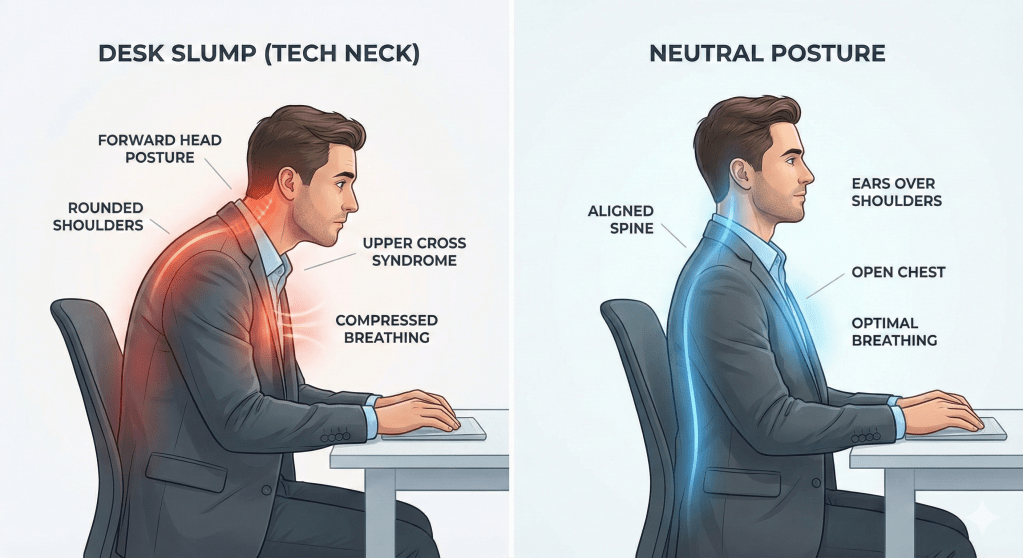
Rounded shoulders and poor posture: Ever catch yourself slumping like a question mark at your desk? Poor posture is practically the default in long meetings and coding marathons. When you slouch, your chest and front shoulder muscles tighten up, while your upper-back muscles weaken from disuse. The result is rounded shoulders and a curved upper spine. This can cause mid-back pain, shoulder impingement (from those rolled shoulders), and even shallower breathing (a compressed chest can restrict your lungs a bit). Over time, staying in this curled-up posture trains your body to think it’s “normal,” making it harder to sit or stand up straight without conscious effort.
Repetitive strain injuries (RSIs): Desk work isn’t heavy labor, but it’s repetitive labor – which can be just as hard on your body. Typing, clicking, and swiping all day involves small, repeated motions and often static wrist/hand positions. This can lead to RSIs like carpal tunnel syndrome (painful tingling in the wrists/hands) or tendonitis in areas like the elbows or shoulders. Keeping a mouse death-grip or pounding the keyboard for hours can inflame tendons and nerves. Plus, holding any awkward posture (like wrists bent or shoulders tensed up to your ears) for too long will cause strain. If you’ve ever felt soreness in your wrists, forearms, or a dull ache in your shoulder at the end of the workday, you might have an RSI.
Why Do These Problems Happen?
So why exactly does sitting in a chair for long periodes of time wreck our muscles and joints? Here’s a simple rundown of the mechanics and physiology behind “sitting disease”:
Use it or lose it – muscle imbalances: When you sit, some muscles are constantly slack (getting weaker) and others are constantly contracted (getting tighter). Think of it as a tug-of-war: for example, a sedentary lifestyle causes your hip flexors to tighten while your glutes lengthen, so they can’t work together properly. Normally, these opposing muscle groups should take turns contracting and lengthening through your range of motion. But sitting glues you in place, so that normal dynamic is shot. The result is muscle imbalance – some muscles become overstretched and weak (like the glutes and overstretched upper-back muscles), whereas opposing muscles become short and overactive (tight hips and chest). These imbalances pull your body out of alignment and make other muscles work harder to compensate, setting the stage for pain and injury.
Joint stiffness and less lubrication: Our joints (like the spine, hips, knees) rely on regular movement to stay lubricated with synovial fluid (it’s like WD-40 for your body). When you hardly move for long periods, joints can become stiff and ligaments around them may tighten. Your lower back and neck are especially vulnerable – a static posture increases pressure on spinal discs and puts strain on ligaments and muscles that normally support an upright posture. Ever crack your back or neck after sitting a long time? That’s your joints craving movement. Without movement, circulation to those areas also drops, so muscles don’t get as much oxygen-rich blood until you move again.
Circulation and “low energy mode”: Sitting too long can put your whole body in a sort of sluggish state. With your large muscles hardly contracting, your blood flow slows down. This can contribute to that foggy, drained feeling you get after afternoon of nonstop sitting. (Fun fact: prolonged sitting even slows your metabolism, making it harder for your body to regulate blood sugar, blood pressure, and break down fat). In short, being motionless signals your body to dial things back, which can leave you feeling zapped of energy.
“Everything’s connected”: A key thing to remember is that your body works as a chain – an issue in one area can trigger pain or problems elsewhere. For instance, your tight hip flexors might be the sneaky cause of your lower back pain, because they pull your pelvis and strain your spine. Or weak glutes could contribute to knee or foot pain, because your poor legs are compensating for weak glute muscles. Forward head posture can even lead to lower back pain, since the spine is one long connected structure. The bottom line: imbalances travel. This is why a sedentary lifestyle can have such widespread effects – one maladaptation sets off a chain reaction from your neck to your feet.
In summary, sitting all day puts your body in “off” mode: certain muscles turn off, circulation dips, and your normal postural alignment skews off-center. The human body is meant to move; when it doesn’t, things start to malfunction (ache, stiffen, weaken) in a pretty short time. The good news? Just as it adapts to bad habits, it can adapt back to good ones when you start moving again!
Beyond Aches: How Sedentary Work Impacts Energy, Sleep, and Mood
It’s not just about muscles and joints – a desk-bound lifestyle can ripple into other areas of your well-being. If you’ve been feeling unusually blah or worn out, your work habits might be a factor. Here are some real-life consequences of too much sitting:
Low energy and fatigue: Ironically, being still all day can leave you more tired than being active. Ever notice how you feel drained after a long couch or desk session, even though you haven’t “done” much? Prolonged sitting puts your body in a sort of hibernation mode – your circulation slows and fewer feel-good chemicals (like endorphins) are released. In one study, when normally active adults were experimentally made more sedentary, they reported significant increases in fatigue and dips in mood after just two weeks. In short, less movement = less energy. On the flip side, a quick walk or stretch break can perk you up by boosting blood flow and nerve activity. So if that mid-afternoon slump hits hard, consider that your body might need a movement snack more than another coffee.
Sapped focus and productivity: It’s hard to do your best work when you’re uncomfortable or exhausted. Pain from poor posture (say, a throbbing neck or back) can be pretty distracting – you might find it harder to concentrate when your body is screaming for relief. Additionally, long periods of work without breaks can lead to mental fatigue and reduced focus. The irony is that powering through without breaks often backfires on productivity. Research suggests that taking short periodic breaks doesn’t detract from performance and can actually boost it. Even micro-breaks (under 10 minutes) have been shown to reduce fatigue and make workers feel more alert and vigorous. In other words, stepping away from your screen for a few minutes to move around can recharge your brain, improving your concentration and output when you return. Compare that to slogging through in a stiff, tired state – the difference in your work quality (and comfort) can be huge.
Mood and mental health: Ever notice how a crummy day at the desk can put you in a cranky mood? There’s a mind-body connection at play. Lack of physical activity is linked to higher risk of anxiety and depression, whereas moving your muscles releases mood-lifting endorphins. Being sedentary, especially if coupled with the physical discomfort it causes, can increase stress and irritability. In fact, studies have found that excessive sedentary time is associated with more frequent mood disturbances and even depressive symptoms. Incorporating activity can improve mood. In the Take-a-Stand Project, for example, workers who alternated sitting with standing reported better mood states along with less pain. The takeaway? Moving more is a natural mood booster, and stuck-in-a-chair syndrome can subtly chip away at your mental well-being.
Sleep quality: Aches and pains from a sedentary day can follow you home and even mess with your sleep. If your neck or back is throbbing when you hit the pillow, you’re in for a night of tossing and turning. Beyond discomfort, there’s evidence that being inactive during the day can contribute to poor sleep at night. Your body craves a certain amount of physical activity; without it, you might not feel as ready for restful sleep. Research has linked high amounts of sedentary behavior with a higher risk of insomnia and sleep disturbances. On the flip side, regular physical activity (even light activity) is associated with better sleep quality. So, if you’re staring at the ceiling at 2 AM, consider that a more active day – with plenty of breaks to move – might help you sleep more soundly. Plus, reducing caffeine and screen time is great, but nothing relaxes you like gently working out those kinks and getting a bit of healthy fatigue in your muscles by day’s end.
Simple Tips to Prevent Pain and Boost Comfort
The good news is you don’t have to quit your office job or become a gym rat to counteract these issues. Small, consistent changes in your daily routine can make a huge difference. Here are some practical, easy-to-implement tips to help save your body (and sanity) during those long work days:
Take frequent “movement breaks”: The absolute best thing you can do is break up long sitting periods. Set a timer or use a reminder app to stand up and move at regular intervals. Experts often recommend aiming for at least a few minutes of activity every 30–60 minutes of sitting. In fact, a recent Columbia University study found that just 5 minutes of walking for every 30 minutes of sitting can offset many harmful effects of too much sitting. So get up, stretch your legs, do a quick lap around the office, or walk to the kitchen for water. Even glute squeezes or calf raises at your desk help get the blood flowing if you can’t leave your workstation. The key is consistency: those tiny breaks really add up. Not only will your body feel better (you’ll notice less stiffness), but you might come back to your tasks with sharper focus and energy. Pro-tip: tie movements to things you already do – e.g., do a stretch every time you hit “Send” on an email, or stand up whenever you get a phone call. Make movement a natural part of your workflow.
Optimize your workspace ergonomics: A few simple adjustments to your desk setup can dramatically improve your posture and reduce strain. First, chair height matters: set your chair so that your feet rest flat on the floor (or on a footrest) with knees bent ~90 degrees, and use a chair that supports your lower back’s curve. Proper desk and monitor height is huge – your monitor top should be at eye level (stack books under a laptop or get a monitor riser if needed) so you’re not craning your neck down. Keep your keyboard and mouse at a height where your forearms are roughly parallel to the floor and your elbows stay close to your body, which helps keep wrists straight and shoulders relaxed. Move the mouse in front of you ,between you and the keyboard, this helps the hardworking musclefibers to relax. Basically, you want a neutral posture: ears over shoulders, shoulders over hips. Adjust your chair backrest to sit upright (or slightly reclined) rather than slouching forward. Also, don’t cradle your phone between your ear and shoulder – use a headset or speaker if you’re on long calls. Little changes like these keep your body in alignment and prevent a lot of aches. As the Mayo Clinic notes, using proper office ergonomics (chair height, equipment spacing, desk posture) can help you avoid neck, shoulder, and back problems. It might take a day to get used to a new setup, but your body will thank you every single day thereafter.
Stretch it out regularly: Incorporate gentle stretches into your day to counteract all that tightness. You don’t need a yoga mat or a special routine – just target the areas that get tight from sitting. For instance, do some neck stretches (slowly tilt your head side to side, or look down and gently roll your head in half-circles) to relieve tech neck tension. Do shoulder rolls and chest-opening stretches (clasp hands behind your back and gently open your chest) to combat that hunched posture. Crucially, give your hip flexors and glutes some love: stand up in a lunge position to stretch the front of your hip (hip flexor stretch), and do a few standing glute squeezes or leg lifts to wake up those dormant butt muscles. Even a simple standing hamstring stretch (touch your toes, or as low as you can go) can relieve your lower back. Aim to stretch at least a couple times a day – perhaps mid-morning and mid-afternoon. Stretching keeps muscles supple and functional, improves your range of motion, and just feels good – consider it hitting the “reset” button on areas that tighten up while you work. Tip: If you’re worried you’ll forget, schedule a quick “stretch break” on your calendar like it’s a meeting. Your coworkers might even join in once they see the benefits!
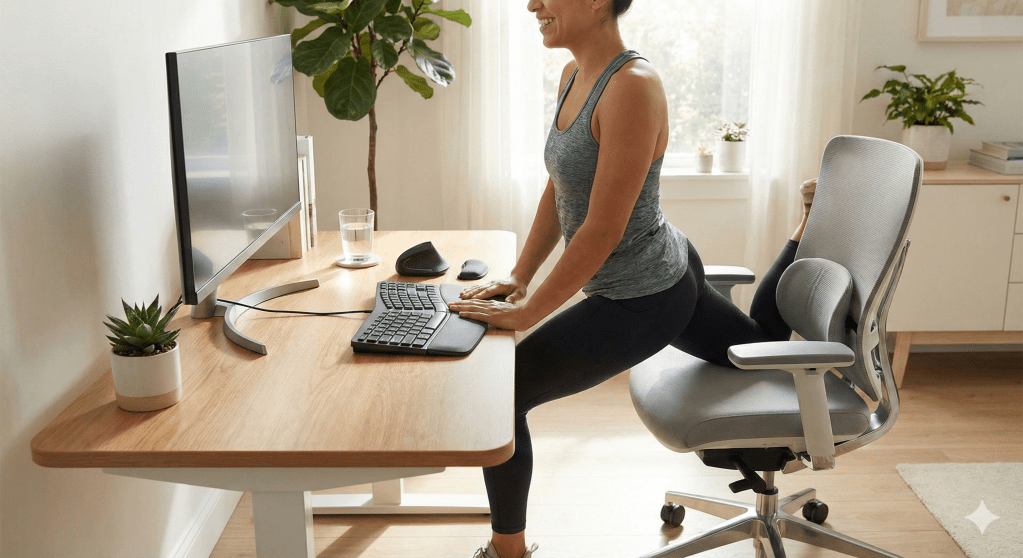
Move or fidget while you work: Movement doesn’t only have to happen during breaks. Try to sneak activity into your tasks. Stand up during phone calls or Zoom meetings if possible (you can even do some light stretches or pacing if the call is audio-only). If you’re reading or brainstorming, consider doing it away from your chair – could you walk around your office or even stand by a counter with your notes? Some people find using a standing desk for part of the day helpful; if you have access to one, alternating between sitting and standing is fantastic for your circulation and posture. No standing desk? Improvise with a high counter or stack of sturdy boxes when you need a change. Even active sitting options like a stability ball or foot pedal can keep your legs engaged. And don’t underestimate the power of fidgeting – small movements like tapping your feet or doing seated ankle rotations under your desk keep blood moving. The goal is to avoid long static stints. By injecting little movements into your routine, you’ll feel less stiff and more alert.
Practice mindful posture check-ins: I get it – you start the day sitting upright, and two hours later you’re unknowingly curled up like a shrimp. Cultivate a habit of self-checking your posture throughout the day. Every 20–30 minutes, do a quick scan: “Where are my shoulders? (Drop them from your ears.) Is my back touching the chair? (Sit back and use that lumbar support.) Are my feet flat on the floor? (Adjust if not.)” Consider a sticky note on your monitor with a posture reminder, or set a subtle phone alarm labeled “Sit tall!” at intervals. Over time, these check-ins will train you to maintain better alignment more naturally. Another trick: each time you return to your chair (say, after getting water or going to the printer), use that moment to reset your posture – plant your feet, roll your shoulders back, and align your head with your spine. You can even imagine a string gently pulling the crown of your head up. This mindful approach helps prevent the gradual slump that happens when we’re absorbed in work. It’s all about awareness – catching yourself in a slouch and correcting it regularly can stave off a lot of pain down the road.
(Bonus tip: Stay hydrated and take eye breaks too! Drinking water will naturally make you get up for refills and bathroom trips, and looking away from your screen every 20 minutes to focus on something distant can reduce eye strain.)
Take Care of Your Body, One Day at a Time
Remember, your body is on your side – it’s amazingly resilient when treated well. By sprinkling movement into your day, tweaking your workspace, and paying attention to your posture, you can prevent many issues before they start (or ease the pains you already have). Think of these habits as daily maintenance, like brushing your teeth. A few minutes here and there to stretch, stand, or walk is a worthwhile investment in feeling good.
Most importantly, listen to your body’s signals. That tight neck or sore back isn’t just annoyance – it’s information. Don’t ignore it! Adjust your setup, move around, do what you need to do to feel better. You’ll likely notice more energy, better focus, and improved mood as you incorporate these changes. Plus, you’ll thank yourself later in life for taking care of your musculoskeletal health now.
So the next time you’re powering through a project and feel that familiar stiffness creeping in, pause. Stand up, stretch, or take a quick stroll. Your body will reward you with more comfort and vigor. You’ve only got one body – and you spend a lot of time in it at work – so give it the care it deserves. Here’s to fewer “dead butts,” less “tech neck,” and a happier, healthier you at the office!
 Musculo